Education
Educators In the Faith
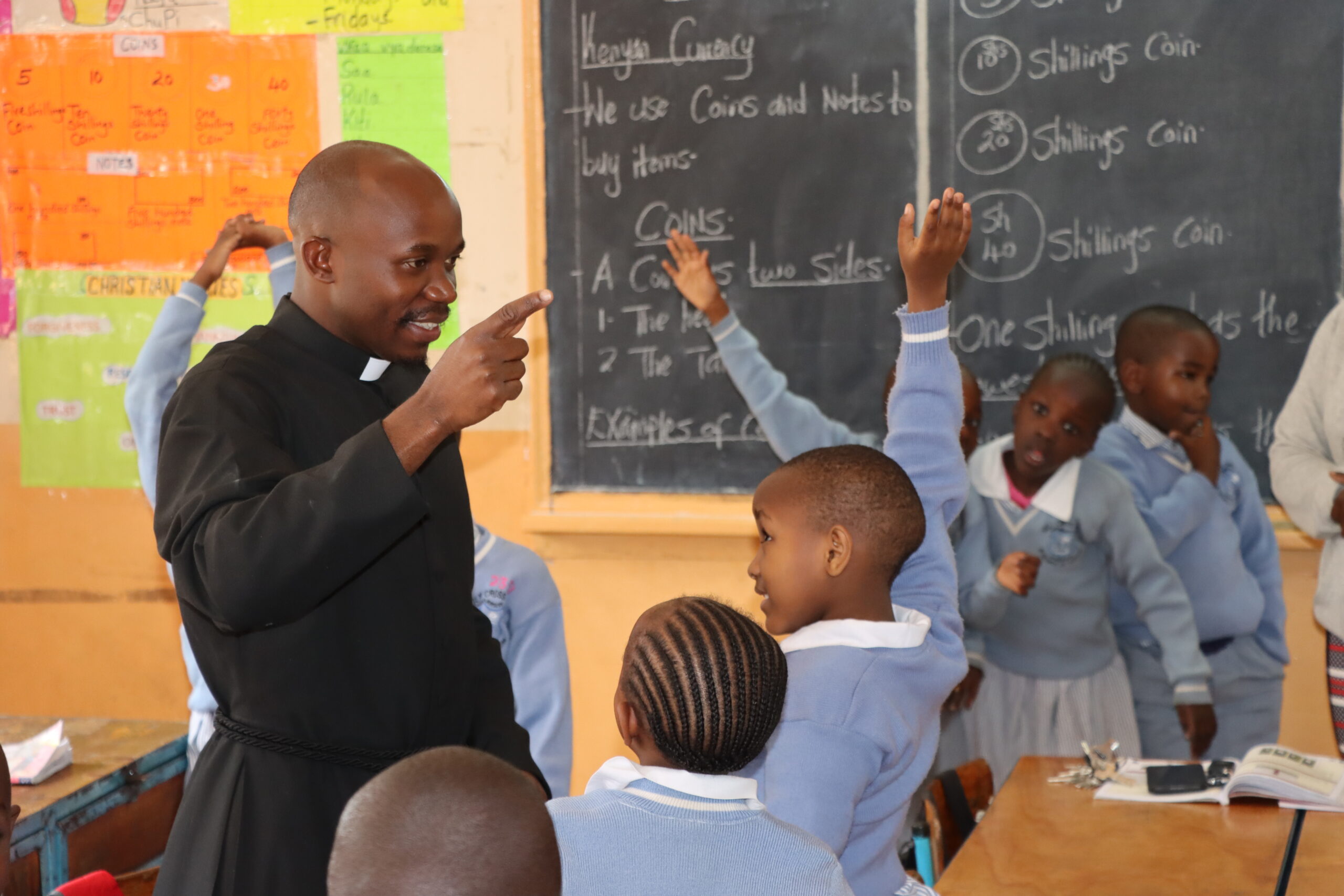
We, as educators in faith, impart knowledge and nurture the hearts of those we serve across various ministries, driven by the fervent zeal to make God known, loved, and served. This passionate commitment stems from the unique gift bestowed upon our Congregation by the Holy Spirit through our founder, Blessed Basile Moreau, enabling us to contribute to the growth of the Church and address the challenges of the world. As men with hope to bring, we strive to embody the transformative power of education and faith.

We teach the Minds and Hearts of all whom we minister to in our different ministries guided by Zeal: the burning desire to make God known, Loved and Served.
Holy Cross and Christian Education
“(Education) is the art of forming young people. For the Christian, this means that education is helping a young person to be conformed to Jesus Christ.” – Bl. Basil Moreau, C.S.C.
With those words, Blessed Basil Moreau began to pen a short treatise entitled Christian Education that was designed to spell out the basics of a Holy Cross education at the primary level. The five principles to follow are clearly evident in this unfinished work’s opening pages and typically characterize modern Holy Cross educational institutions throughout the world, even as those have grown to include much more advanced ones of higher learning than anything Moreau envisioned. Drawing upon letters, sermons, Christian Education and other writings of Moreau, it is clear how that charism continues to influence the community’s mission of education and evangelization in the world and render a distinctive character to its ministries. As the years have unfolded and Holy Cross has delved deeper into the writings of the founder and his legacy and come to see with more clarity the depth of his vision, there are five elements that define a Holy Cross education and are universally evident, they include..

The five elements that define a Holy Cross Education
Mind: Seeking understanding through the integration of faith and reason.
A Holy Cross education begins with a rigorous and full development of the mind. Moreau himself was a committed student who took his studies seriously and engaged energetically in the intellectual debates of his day. He perceived early on that it could only be detrimental to both Church and society were Catholics to refrain from engaging the scholarly questions and controversies of the age. Like John Henry Cardinal Newman, his contemporary, Moreau sought to instill within students the belief that reason and faith were complementary aspects of God’s revelation. He resisted the post-Enlightenment tendency to compartmentalize theology and rely solely upon human knowledge. In later decades, as he fought for Holy Cross schools to gain acceptance and credibility, Moreau realized that the students who graduated from them would need to familiarize themselves even with theories and beliefs they opposed and become smarter, more determined, better debaters who could hold their ground on others’ turf.
Heart: Discerning our personal vocation in service to the Church and world.
Having come of age in the wake of the French Revolution, Moreau knew firsthand that an education which imparts knowledge without values and faith can produce people with sharp intellects but malformed hearts. He was undoubtedly influenced by a wise spiritual advisor who counseled him, “Our first rule must be to disregard what only tickles the ears; it is hearts that we must win.” For him, the development of the heart was rooted in our essential dignity as God’s children. It is a relationship that is made explicit and central in our baptism. The unfolding of our baptismal identity and call is at the core of the cultivation of the heart and the fulfillment of our deepest desire to live in union with God as citizens and leaders in service to the Church and world.
Zeal: Fueling the desire to offer our gifts for the good of all people.
Zeal was the term Fr. Moreau used to express the virtue that actualizes the development of our minds and the cultivation of our hearts for the good of others. An education of minds and hearts can only set the world on fire if it has truly enkindled within a person the desire to act boldly. He benefitted personally from the opportunities that followed to develop his intellect into a powerful means for communicating the gospel to disparate audiences from seminarians to poor country folk who could not sign their names.
But he always understood that it was one’s longing for God and commitment to a life of faith that sustained the use of those gifts for the good of others. Ultimately, he believed Holy Cross schools should help a young person come to a clear understanding of his or her vocation in the Church and in the world, irrespective of our individual roles or responsibilities. He insisted on a preference for “the most abandoned, the most ignorant, the least gifted by nature … because their needs are greater and it is only justice to give more to those who have received less.”
Family: Embracing Christian community as the context for lifelong formation.
Moreau realized that he would never have become a priest but for the influence of his family and also his parish priest who first recognized the stirrings of a vocation and arranged for his education. If people associated with Holy Cross speak frequently today about the “family-like” atmosphere they encounter in our parishes and educational institutions, that is directly traceable to Fr. Moreau’s teaching philosophy and ideals for community life. His modeling of each group within the Congregation, priests, brothers, and sisters upon the image of the Holy Family, caused him to cultivate an environment at Sainte-Croix that would make it feel like the kind of home in which he was raised.
It is that family-like atmosphere that constituents typically identify as the most distinguishing feature of a Holy Cross apostolate. It is, however, an elusive and ephemeral quality, felt more easily by people who have experienced it than readily describable, even for those who have enjoyed a long association with Holy Cross. Though it is arguably the community’s most appealing quality, few would know that what they sense intuitively in a Holy Cross school or parish today was the product of Fr. Moreau’s pastoral genius.
Hope: Trusting in the cross and God’s promise of the kingdom.
Moreau’s spirituality was rooted in the desire to be an apostle, to pick up his cross daily and conform himself wholly to the person of Jesus Christ. He sought to make the Congregation an extension of his zeal for mission and devotion to union with mixed results, but his influence continues to permeate how Holy Cross expresses itself today. Were it not for Moreau’s faith and fortitude no matter his disappointments, the other four principles of mind, heart, zeal and family would have little meaning or purpose. However, they are the foundation for a unique pedagogy that mirrors a person’s natural human development and moral formation along the path of Christian discipleship. Ultimately, his vision encourages us to embrace the cross of Jesus while progressing through this world toward the light of God’s kingdom. Moreau’s educational philosophy was rooted in the belief that we should prepare students to act and engage fully as citizens of this world in preparation for citizenship in heaven.
While the work of Holy Cross began in education and parish ministry, our mission takes across borders of every sort. For the East African Province, our mission includes ministering in parishes, schools, colleges/ Universities, Holy Cross family ministries, Health Centers and Formation Houses with preferential option to the poor. Educating the Mind and the Heart to give Hope.
Stay informed of the latest updates from the East African Province of Holy Cross.
Join a Brotherhood of Men with Hope to Bring
Discern your vocation and discover the life God is calling you to live.